
Introduction
Kalidasa is hailed for his intricate delineation of the major and minor characters in Abhigyanashakuntalam. His approach to characterization in Abhigyanashakuntalam reaches a new level of artistry. In the first five acts, we primarily see three types of characters.
- First, there are individual characters, on the one hand, while some are fully developed and more complex, like Dusyanta and Shakuntala, on the other hand, there are others who are more static, like the minor figures like Vaikhansa (Act I), Raivataka (Act III), and the unnamed Disciple (Act IV).
- Second, there are groups of anonymous or stock characters who act together somewhat like a chorus. These include Vaikhansa’s two disciples (Act I), the three unnamed wives of ascetics (Act IV), and the larger group of ascetics accompanying Shakuntala (Act V).
- In the praveshaka (interlude) of Act VII, Kalidasa introduces a third form of characters. Instead of assigning the task of recovering the lost ring to a single notable character or a chorus-like group, as might be typical in Greek tragedy, he gives this responsibility to a dramatic ensemble. This ensemble isn’t a chorus, nor is it simply a group of actors working together in performance. Rather, it’s a dramatic device: a group of distinct individuals whose collective actions move the plot forward. While each member has their own identity, their role in the story is defined by their shared function within the narrative.
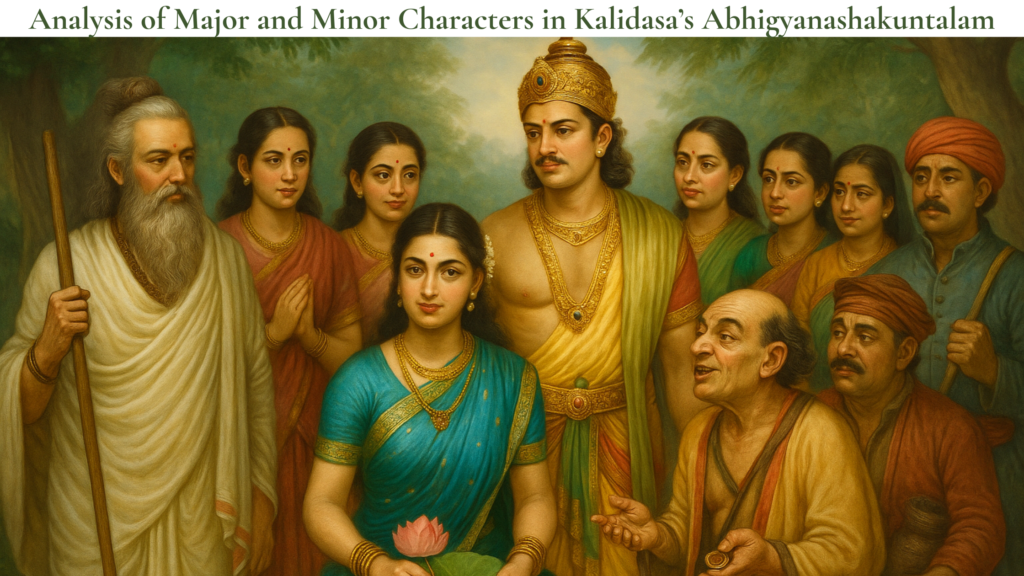
Major and Minor Characters in Abhigyanashakuntalam.
Dusyanta
In classical Sanskrit drama, the hero of a ‘nataka’ is typically driven either by love or by heroic energy. In Abhigyanashakuntalam, Kalidasa blends both the forces of the romantic and the heroic in Dusyanta. While one emotion usually dominates in such a narrative, the other often serves as a vital undercurrent. Thus, even in a love-centered story like this one, Dusyanta’s heroism is never absent. He is portrayed as “consistently noble,” and the woman he desires, Shakuntala, is his equal in character, as revealed most clearly in Act IV. Their reciprocal longing for one another drives the play’s dramatic action.
Kalidasa carefully constructs Dusyanta’s character even before his first onstage appearance. The opening scene describes him as strong, observant, eloquent, agile, and morally grounded, even amid the excitement of a hunt. Once he sets his sights on Shakuntala in Act I, he begins to show his charm and refinement, social grace, romantic subtlety, and determination. With the young women in the hermitage, he is modest and courteous, guiding the flirtation through gentle conversations, always steering toward his ultimate goal with tact and clarity.
Acts II and III expand on his personality through interactions with supporting characters. Dusyanta’s physical prowess is highlighted by Bhadrasena; his poetic, romantic nature is drawn out in conversations with Madhavya; Gautama and Narada reflect his majesty and inner discipline; and his tenderness as a son is revealed through Karabhaka’s message from his mother. By the time we see him again in Act III, pining for Shakuntala and overcome with desire, Dusyanta is no longer just a noble king, we see him as a fully human lover, wrestling with deep emotions and growing self-awareness.
When we reach Act V, we witness another dimension of his character: the conscientious king. Dusyanta is now seen as a ruler who is just and diplomatic, a masterful debater who must use all his skills to balance personal pain with public duty. Under intense emotional and political strain, he still manages to uphold law and decorum, even as the truth about Shakuntala eludes him. The act poses challenging questions: What does it mean to be a virtuous king? Is the title of ‘rajarshi’ (royal sage) earned or merely bestowed? Kalidasa doesn’t provide easy answers. Instead, through irony and subtle hints, he invites the audience to examine Dusyanta’s public and private selves.
Act VI brings us closest to Dusyanta’s inner world. Here, guilt consumes him. He expresses remorse without self-pity, descending into despair and psychological confusion. In this state, he loses grip on reality, collapsing under the weight of memory and regret. Yet, even amid his breakdown, Kalidasa allows flashes of his noble character to shine through: as a generous ruler, a loyal friend, and an inspiring leader. This act captures Dusyanta’s emotional complexity more vividly than any other.
Act VII elevates him to his fullest stature. He is now a complete hero: a fearless military leader, a devoted father, a faithful husband, and a cosmic citizen who communes with the divine. Kalidasa synthesizes every aspect of Dusyanta’s personality, his strength, intelligence, sensitivity, and sense of duty, into a unified, exalted figure.
Still, the play never lets us forget the tension between appearance and reality. In Act I, Dusyanta removes his royal insignia before entering Kanva’s hermitage. This symbolic act strips him of his kingly persona and allows him to appear as a humble visitor. It is both a gesture of respect and a narrative device, allowing Shakuntala and her companions (and the audience) to see him as a man first, not a monarch. But this disguise is also a mask, just like his royal image. The interplay between these two personas, the public and the private, is a recurring theme throughout the play, explored in his candid asides and relaxed exchanges with Madhavya. These moments offer vivid glimpses into Dusyanta’s true nature, contrasting the grand, polished verses used to depict his public image.
Kalidasa further complicates Dusyanta’s character by showing how his past informs the present. Allusions in the play suggest that Dusyanta may have had a history of romantic dalliances. Madhavya teases him about his wandering eye, and Dusyanta’s reaction to a love song in Act V suggests a capacity for emotional detachment if not callousness. His comment, “Yes, I once loved you deeply…”, comes across as cold, hinting at the cruel rejection to come. Yet Kalidasa doesn’t reduce him to a philanderer. Instead, Dusyanta is depicted as a man capable of great love but also great error- human in the fullest sense.
Viewed through a classical lens, Dusyanta is not merely a type- the noble dhirodatta nayaka or ideal king, but a character in transformation. His qualities are constant, but their expressions evolve with each act. His character arc is shaped by circumstance, emotion, reason, and morality. His growth unfolds organically across the play’s structure, culminating in a rounded, deeply human portrait.
When viewed outside the framework of classical Sanskrit poetics, Dusyanta still stands as a hero bound by natural laws and human limitations. He is not superhuman, though he sometimes approaches that stature through divine intervention. He cannot find Shakuntala on his own after she is taken away; he cannot overcome his mental breakdown without Matali’s intervention; and he cannot reach Mount Meru without celestial aid. His life is governed by dharma in all its forms: divine law, royal duty (rajadharma), caste responsibilities (jatidharma), general ethics (sadharana dharma), and personal morality (svadharma).
This layered understanding of Dusyanta helps explain why he must embody such a broad range of qualities. To fulfill his role as king, father, and lover, he must be a “hyper-human” figure, someone who excels in intellect, emotion, strength, sensitivity, discipline, and art. He is a warrior (chakravartin), a sage-king (rajarshi), and a lover-poet (rasika) all in one. Through him, Kalidasa explores the full spectrum of human experience, placing him at the edge of romance and myth, far from the tragic figures of Greek drama. Dusyanta is not destroyed by a single fatal flaw. Rather, he journeys through error, insight, loss, and rediscovery, emerging as a hero whose greatness lies in his humanity.
Shakuntala
In classical Sanskrit drama, characters are often archetypal rather than realistic. The focus tends to be on idealized figures, the noble, powerful hero; the virtuous and beautiful heroine; the clever, often gluttonous companion; loyal ministers; and witty servants. These types serve to express universal qualities, in contrast to the psychologically distinct and individual characters found in much of Western drama, such as Hamlet, Macbeth, or Hedda Gabler.
While many Sanskrit plays rigidly follow the conventions outlined in the Natyashastra, sometimes producing flat or lifeless characters, there are notable exceptions. Among these, Shakuntala, the heroine of Kalidasa’s celebrated play Abhigynanashakuntalam, stands out as one of the most nuanced and fully realized characters in all of Indian literature.
When we first meet Shakuntala, she is a child of nature. She is innocent, spontaneous, and on the verge of womanhood. Her youthful charm is part of what captivates King Dusyanta. Though she speaks no words to him during their first encounter, her glances reveal mutual attraction. By Act III, we see her openly confide in her friends about her feelings for the king, though she quickly retreats into shy silence when Dusyanta steps forward to express his love. The act closes with a telling repetition of Act I’s ending: she lingers to catch a glimpse of the King, confirming her emotional awakening.
Act IV, widely considered the emotional heart of the play, shows Shakuntala preparing to leave the forest hermitage for the royal court. Her farewell to the plants, animals, friends, and her foster father Kanva is filled with deep emotion. Here, her innocence is touched by sorrow, and we witness the painful transformation of a girl stepping into an unknown world, trusting in love.
But her reception at court is disastrous. In Act V, Dusyanta, under the influence of a curse, does not recognize her. His words are cruel, comparing her to a cuckoo that abandons its young. The insult stings deeply, not just because it denies her identity but because it echoes her own abandonment by her celestial mother, Menaka. Stripped of dignity and accused of deception, Shakuntala is publicly humiliated. Her passionate response and tears, however, reveal a new layer of strength and self-respect.
In Act VI, we learn that Shakuntala, now in celestial exile, is grief-stricken and physically diminished. By the time she reappears in the final act, she has become a mature woman, a mother, still humble and tender, yet transformed by experience. Her emotional depth and moral clarity have only deepened.
Kalidasa’s Shakuntala is more than just an archetype; she is one of the most vivid portrayals of womanhood in Indian literature. Though shaped by the dramatic norms of the Natyashastra, Kalidasa infuses her with imagination, subtlety, and inner life. She begins as a 16-year-old girl as a ‘bala’, as Dusyanta calls her, leaving the safety of her hermitage for the first time to stand trial in the sacred fire enclosure. This is no ordinary courtroom but a spiritual space where truth is meant to be self-evident. And yet, here she faces rejection and insult.
Ironically, this sacred space, chosen by Dusyanta himself as a fitting place for ascetics, is also the very site of her public disgrace. Yet the divine fire has already affirmed her marriage to Dusyanta and foretold the greatness of their son. The sanctity of her union is never in question, even if her husband forgets it.
Kalidasa’s version of the story, drawn from the Mahabharata, differs significantly from the original. In the epic, Shakuntala is fierce and argumentative, unafraid to challenge the king with logic and anger. Kalidasa softens this portrayal, weaving a complex narrative of emotional evolution, social challenge, and spiritual resilience. He introduces new elements, the curse, the lost ring, and a supporting cast not found in the epic, creating a play that is structurally rich and emotionally profound.
Shakuntala’s deep connection with nature, her role as guardian of the hermitage, and Dusyanta’s dreamlike descriptions of her (“Was it a vision? A dream?”) suggest her origins may lie in older mythic traditions, perhaps even a now-lost folktale involving a divine or semi-divine maiden. The repeated use of the word ‘moha’, meaning illusion, confusion, or delusion, underscores this blend of the real and the supernatural. Dusyanta’s forgetfulness, caused by Durvasa’s curse, is described in metaphors of blindness and veiling, further emphasizing the theme of obscured truth and recognition.
Importantly, many of Shakuntala’s key life events, her union with Dusyanta, the curse, the discovery of her pregnancy, and her celestial journey, take place offstage. They are reported rather than enacted, creating a fractured but rich narrative. Nonetheless, when we track her appearances across the play, in Acts I, III, IV, V, and VII, we see a clear arc of transformation. She begins as an impulsive, spirited girl and becomes a dignified, independent woman. Her consistency lies not in sameness but in the integrity of her evolving self.
Even in moments of crisis, Shakuntala remains bold. When Dusyanta attempts to return the lost ring in Act VII, she refuses to accept it until he has proven himself. Her sense of self-worth and emotional honesty never waver. Her resilience mirrors that of Dusyanta himself, and it’s no surprise that their son, Sarvadamana, inherits their combined strength of spirit.
Kalidasa’s characters are not static figures but dynamic individuals with inner complexity (svabhava). They act with thought and emotional depth, adapting to circumstances in ways that feel lifelike and compelling. Shakuntala, in particular, embodies this realism. She is never reduced to a single trait or type. Instead, she becomes a continually evolving person, strong, sensitive, and unforgettable.
Kanva
Kanva serves as the conservative core of the play, especially in relation to the social and spiritual structures defined by the varnashrama system, India’s traditional framework that divides society into four castes and life into four stages, each marked by sacred rites. While some conservative scholars have considered four of Kanva’s Sanskrit verses (Verses 78, 81, 89, and 90) as among the finest in the play, their value lies more in their moral clarity than in poetic imagination. These verses offer ethical guidance rather than artistic depth, positioning Kanva as a moral rather than aesthetic centre.
Though Kanva appears only after the play’s initial synthesis (Act IV), he becomes a grounding force. However, the narrative’s final resolution is guided by another pivotal character, Kashyapa, introduced in Act VII. Kashyapa, a divine figure, is the son of Marichi and grandson of Brahma, the creator-god. His lineage is deeply mythological, as he and his wife Aditi are parents to Indra, king of the Vedic gods, and to one of Vishnu’s early incarnations, the Divine Dwarf (Vamana). Kashyapa’s vast mythology includes fathering gods, demons, celestial beings, and parts of humanity over thousands of years. As one of the Prajapatis (Primordial Progenitors), he brings divine order to the story’s chaos. In the final scene, he restructures the tangled events involving Dusyanta and Shakuntala, resolving them across time, causality, and morality.
Interestingly, Kanva is portrayed as a patrilineal descendant of Kashyapa. Despite this divine ancestry, Kanva appears as a human rishi, a sage who serves as a bridge between gods and humans, preserving divine law in the human world. Both in Kalidasa’s play and in the Mahabharata, Kanva is not only Kashyapa’s descendant but also the revered visionary who, along with his family of poets, helped compile many hymns in the eighth mandala of the Rig Veda. This connection grants him immense spiritual authority, which Kalidasa highlights in Act IV when Kanva chants a Vedic mantra to bless Shakuntala’s journey to Hastinapura.
Kalidasa also infuses the Hermitage setting with gentle irony. The ascetics, portrayed as peaceful and nurturing like the deer they care for, are described as containing hidden, blazing energy. Yet, it is not Kanva or his disciples who erupt with passion, but the outsider sage Durvasa, who lashes out when he feels ignored, unfairly punishing the innocent Shakuntala. Through this contrast, the play questions the ideal of asceticism, contrasting the self-important Durvasa with the compassionate and composed Kanva. Kanva is portrayed as the ideal sage: wise, kind, restrained, and deeply understanding.
Act V continues this scrutiny, especially of Kanva’s disciples. Sarangrava is hot-tempered and arrogant, showing traits that suggest he could become another Durvasa in time. He even fails to deliver Kanva’s message to the king in the sage’s own words, acting instead out of personal anger. Saradvata, on the other hand, is rigid and cold, obsessed with purity rather than compassion. These disciples fall short of the ascetic ideals they are meant to embody. Ironically, the only person who treats Shakuntala with humanity during the trial scene is the royal priest, whom the disciples openly scorn. He alone shows her compassion and is the first to witness the divine miracle of Shakuntala’s disappearance.
Kanva, as a ‘kulapati’ (head of an ascetic community), is widely revered. Even King Dusyanta expresses deep respect for him, acknowledging his divine power earned through immense penance. Yet, this reverence has no effect on the King’s judgment of Kanva’s daughter. His decisions are influenced not by Kanva’s standing but by how his disciples, particularly Sarangrava, frame the situation.
Instead of treating Shakuntala’s marriage as sacred, the disciples present it on a quasi-legal basis, introducing public opinion and legal proof into a space that should have remained spiritual. This plants doubt in the King’s mind about the marriage’s legitimacy and the unborn child’s status. The epic version of the tale makes these doubts explicit; Dusyanta cites them as reasons for rejecting Shakuntala. When challenged, Sarangrava cannot provide a satisfying answer, and the situation spirals into a legal dilemma: either the King deserts a lawful wife or commits an act resembling adultery. Caught between two sins, he chooses to reject her.
Thus, the hermitage, once a sacred sanctuary, unintentionally becomes a courtroom. Shakuntala cannot prove her marriage because she has lost the ring that was her only evidence. In a moment of utter despair, she calls out to the heavens for death. Miraculously, a divine light appears, and she is taken away, never to return to this world.
The final reunion of Shakuntala and Dusyanta occurs not in the earthly realm but in a divine one, the “golden world” of the Primal Pair. The plot’s resolution, achieved through a ‘deus ex machina’, brings a temporary sense of peace, but the underlying tragedy remains. The play ends not with full closure, but with the lingering echo of what was lost.
Madhavya (The Vidusaka)
In Sanskrit dramatic tradition, Madhavya is portrayed as King Dusyanta’s closest childhood friend. This deep bond of trust, affection, and loyalty explains why Dusyanta risks his own life to save Madhavya in Act VI, when his friend is in danger. Despite being a poor, educated Brahmin, vegetarian, fond of sweets, short-sighted, tactless, occasionally foolish, and prone to speaking Prakrit instead of Sanskrit, Madhavya is a unique and pivotal character. He may appear comical and underinformed, but he’s the one who helps Dusyanta navigate his emotions in Act II and maintain his composure under extreme psychological pressure in Act VI. He alone is entrusted with delicate personal and political missions, showing just how much the king values him.
Madhavya is not just a comic relief. As the ‘vidusaka’ or court jester, a staple figure in Sanskrit drama; he serves two key purposes. First, he is a source of humor, with his awkward appearance, quirky habits, and sharp wit. Second, he is a social critic, using satire to cut through the pretensions and delusions of those around him, including the king himself.
Importantly, Madhavya is a jester, not a trickster. This distinction is central to understanding his role. He grounds the play in reality, offering practical wisdom and common sense amidst the mythic and romantic grandeur of the main plot. For instance, when Dusyanta is enraptured by Shakuntala’s divine beauty, Madhavya bursts the bubble with the blunt question: “Did you think she’d jump into your lap the moment she saw you?” He’s not afraid to poke fun at the king’s passions, counterbalancing the emotional intensity of scenes with ironic, often hilariously subversive comments.
Throughout the play, Madhavya acts as both a comedic counterweight and a voice of reason. His teasing reminds the audience not to take the royal declarations too seriously. In Act II, as Dusyanta laments his unrequited love, Madhavya jokingly raises his stick to “banish this sickness of love.” His realism and irreverence puncture the king’s lofty speeches, injecting both humor and perspective into the narrative.
But Madhavya’s significance extends beyond humor. His absence in key scenes in Acts III, IV, and V, is telling. It allows the romantic plot between Dusyanta and Shakuntala to unfold without interference and ensures the king’s magical memory loss (caused by the sage Durvasa’s curse) is believable. With Madhavya absent, the story transitions from the union of lovers (sambhoga shringara) to their painful separation (vipralambha shringara), emphasizing the emotional arc of the play.
Despite being mocked for his hunched back and awkward appearance, Madhavya is no fool. He even mocks himself, as when he describes a bent reed swaying in the river “with the grace of a hunchback’s gait.” His humor often carries a note of sadness, common among great jesters who, while making others laugh, quietly bear their own burdens.
The intimacy between Dusyanta and Madhavya is deeply felt. They share the comfort and teasing familiarity of lifelong friends. Madhavya often calls the king “dear friend”, and is one of the few people with whom Dusyanta can drop his royal facade. Their banter is light-hearted but layered with critique. For example, Madhavya complains of aching joints from chasing the king on endless hunts, slipping in jabs about the king’s neglect of state duties for the pleasures of the chase, and of love.
This jester knows how far to push his luck. He never oversteps, aware that even close friends can face a monarch’s wrath. But his jabs are sharp, as when he wryly remarks: “Do you hit me in the eye and then ask why it’s watering?” Comparing himself to a reed tossed by a river’s current, he subtly points out that it’s Dusyanta’s actions, not his own weakness, that have caused his distress.
Madhavya’s commentary continues to highlight Dusyanta’s flaws. When the king waxes lyrical about Shakuntala, Madhavya deflates the sentiment by likening her to “sour tamarind,” a sharp contrast to the king’s metaphor of “fragrant jasmine.” His sarcasm often redirects Dusyanta back to reality.
Importantly, Madhavya brings necessary balance to the court. While others shower the king with flattery, Madhavya’s grounded wit offers fresh air. He is critical, but always loyal. His departure at the end of Act VI is handled with dignity. Entrusted with informing the Chief Minister about the king’s new mission and the reasons behind it, Madhavya exits the play quietly. His role is complete, his presence no longer needed as Dusyanta moves into a new realm of maturity and myth.
By Act VII, Dusyanta is no longer the man he was. Having experienced loss and remorse, he matures into a compassionate ruler. His decree that a merchant’s estate go to an unborn child rather than the state shows a newfound sense of justice and empathy. His love for Shakuntala, once shallow and impulsive, is now deep and genuine, a recognition of true worth, or abhigyana.
Madhavya, grounded in the material world, doesn’t belong in this “golden world” of divine beings and cosmic battles. He scoffs at ascetics with oily hair and greasy beards; we cannot imagine him praising celestial beings or joining the spiritual realm. His story, while deeply intertwined with Dusyanta’s, ends where the mythic begins.
Significantly, Madhavya never meets Shakuntala in person. Unlike the vidusaka in Kalidasa’s other plays, Madhavya exists outside the heroine’s world. He knows her only through Dusyanta’s eyes and voice. Kalidasa carefully keeps their worlds apart, a poetic choice that underscores Madhavya’s earthly role.
In his final appearance in Act VI, Madhavya plays a vital part in lifting Dusyanta out of despair. Through humor and pragmatism, he coaxes the king back to mental stability. Even in scenes where Dusyanta is wracked with guilt, Madhavya’s banter, absurdity, and realism pull him back from the edge.
Madhavya’s highest function is revealed here: laughter is not just comic relief; it is healing. His presence shows that wit and common sense are not merely subversive tools, they can also restore order and sanity. Madhavya may be a secondary character, but Dusyanta’s journey is incomplete without him.
At one point, caught between obligations to both sage and mother, Dusyanta is paralyzed with indecision. Madhavya quips, “Suspended mid-air like Trishanku,” turning the king’s crisis into comic relief. Later, when appointed to represent Dusyanta in courtly duties, he boasts, “I feel like the Crown Prince.” This mix of humor and loyalty is central to Madhavya’s character, and to the play’s emotional rhythm.
Anasuya and Priyamvada
In traditional Sanskrit literary criticism, Anasuya and Priyamvada are often seen as stock characters, the standard “sakhis” or close female companions of the heroine, with little individual identity or emotional depth. However, Kalidasa breaks this convention. He gives both women distinct personalities, inner lives, and meaningful roles that go far beyond their expected functions in the plot. Even minor characters in Shakuntala, like the Disciple who briefly appears in Act IV, are portrayed with vivid emotional and intellectual presence, and Anasuya and Priyamvada are no exception.
Among them, Anasuya stands out as a well-rounded character, almost like an adult figure in the play. She is thoughtful, emotionally composed, and morally discerning. She consistently shows care for those around her such as Shakuntala, Priyamvada, Kanva, and the ashram community. But she is more than just nurturing. In a revealing soliloquy in Act IV, Anasuya reflects deeply on her own emotions and navigates complex social circumstances, like Shakuntala’s unacknowledged pregnancy. Her handling of the first conversation with King Dushyanta in Act I showcases her intellect and tact: she quickly assesses his character, engages in a balanced yet formal exchange, and manages a delicate social dynamic, all while interacting with a powerful stranger who initially hides his true identity.
Anasuya plays a pivotal role in developing Shakuntala’s relationship with Dushyanta. She helps Shakuntala recognize her own feelings, encourages the budding romance, and actively facilitates their interactions. In Act I, she begins a meaningful conversation with the king, answers his questions, and tells him about Shakuntala’s background. In Act III, she and Priyamvada cleverly leave the couple alone and later warn them of Gautami’s approach. In Act IV, she breaks the news of Shakuntala’s pregnancy to Kanva, though he already knows it through mystical insight, and makes the crucial decision to withhold Durvasa’s curse from Shakuntala, knowing that the heroine is too distracted to fully hear or grasp its meaning. As a fully developed character, Anasuya becomes second only to Kanva in advancing the secondary plot and supporting the main narrative.
While Priyamvada sometimes appears to blend into Anasuya, especially when they speak in unison or plot together to support Shakuntala, her character has its own distinct qualities. She is more spontaneous, emotionally reactive, and far less measured than Anasuya. Where Anasuya thinks before she speaks, Priyamvada tends to act on impulse, like when she runs after the enraged sage Durvasa in Act IV. She’s also known for her talkativeness, with Shakuntala herself jokingly calling her “this prattling Priyamvada and her nonsense” in Act I.
Despite this impulsiveness, Priyamvada plays a vital role in the plot. In Acts III and IV, she encourages Shakuntala to be more open with Dushyanta, comes up with the clever idea of writing a love letter on a lotus leaf, and; most crucially, persuades Durvasa to soften the terms of his curse. This amendment introduces the ‘Ring of Recognition,’ a key plot device that ultimately enables Dushyanta to recover his lost memory.
Together, Anasuya and Priyamvada are not only Shakuntala’s closest companions, but also dynamic characters in their own right. They balance and complement each other; Anasuya with her maturity and restraint, Priyamvada with her energy and emotionality. As such, they act like quotation marks around the events of the secondary plot, defining, containing, and shaping its development with intelligence, emotion, and unwavering loyalty.
Minor Characters
Act VI of Shakuntala introduces a unique dramatic ensemble; four minor characters who, together, play a crucial role in shifting the course of the story. Each has a distinct stage presence, yet they function as a tightly coordinated group whose combined actions drive a key turning point in the plot.
This ensemble includes the City Superintendent, who is the brother of one of King Dushyanta’s lesser wives; making him the King’s brother-in-law. Despite this connection to royalty, he is portrayed as a morally dubious figure. Then there are his two subordinates, caricatured policemen named Suchaka and Januka, nicknamed “the informer” and “the informed,” respectively, who serve as comic figures. Rounding out the group is a Fisherman, considered the lowest-ranking character in the play, as he belongs to a caste historically labeled “untouchable” due to his occupation.
What sets this group apart from other collectives in classical drama; such as the Greek chorus, which often featured 12 to 15 actors offering commentary on the action, is that Kalidasa’s ensemble doesn’t speak or act as a single voice. Instead, each member plays a distinct, non-interchangeable role in a shared task. None of them can recover and return Dushyanta’s lost ring on their own; only by working together can the ring and the truth be restored. They enter together in the marketplace scene and exit together after the interlude, heading off to a wine shop, transformed by their brief moment in the spotlight.
Kalidasa was a pioneer of this kind of dramatic ensemble, long before it appeared in Western theater. Shakespeare later reinvented the idea for the modern stage. In A Midsummer Night’s Dream, the comic group of amateur actors functions as a lighthearted ensemble, while in Romeo and Juliet, the feuding Capulets and Montagues form opposing group ensembles that fuel the tragic tension on the streets of Verona.
In both classical and modern contexts, a dramatic ensemble works best when the task it is assigned is complex and requires multiple characters to complete different parts. For the ensemble to succeed, each character must be tailored to their role, ensuring that the group’s purpose, cohesion, and dramatic impact are fully integrated into the story.
In Abhigyanashakuntalam, the interlude in Act VI—known as the ‘praveshaka’, serves as a standalone comic episode that nonetheless connects directly to the main plot. It is through this ensemble that key events unfold: the Fisherman finds the lost ring; the Superintendent and his officers investigate how it came to light; and, thanks to the Superintendent’s family connection to the King, they are able to deliver both the ring and its story directly to Dushyanta. This crucial act lifts the fog of Durvasa’s curse, restoring the King’s memory and reuniting him with his lost love.
Conclusion
Kalidasa’s Abhigyanashakuntalam presents a rich variety of characters, each contributing to the timeless narrative of love, duty, and destiny. The major characters, including Shakuntala, King Dushyanta, and Sage Kanva, drive the central plot, while minor characters like Priyamvada, Anasuya, and Madhavya add depth and complexity to the story. Through intricate character development and relationships, Kalidasa masterfully effectively underscores the complexities of human nature and the interplay between divine intervention and mortal choices. Through the aid of this efficient characterization, the readers and audiences continue to engage with this classic work, they are invited to reflect on the universal themes and timeless wisdom embedded in Kalidasa’s work, finding resonance in their own lives and experiences.