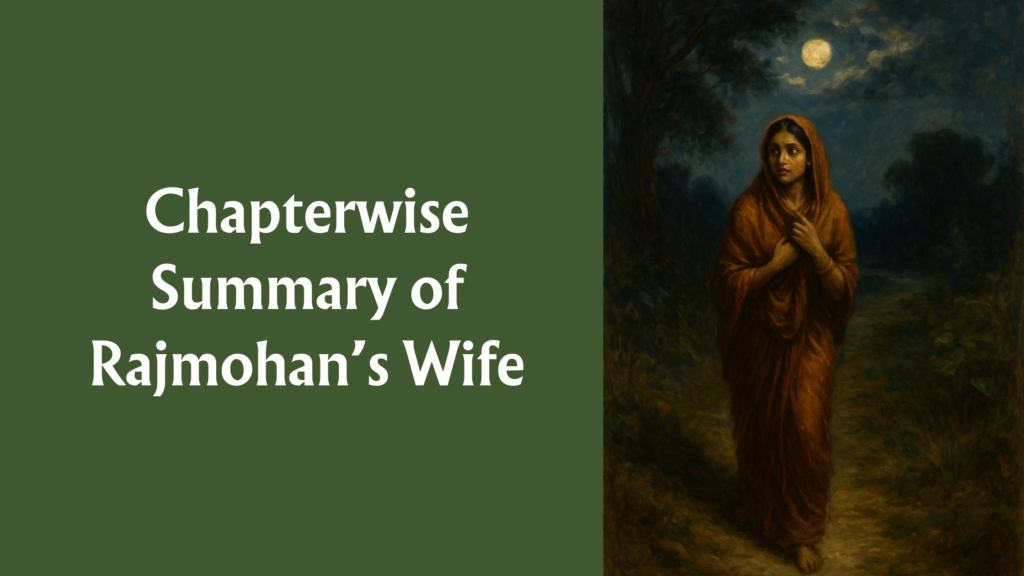

Chapterwise Summary of Rajmohan’s Wife
Chapter I- The Drawers of Water
Chapter I of Bankim Chandra Chatterjee’s Rajmohan’s Wife, titled “The Drawers of Water,” opens in a quiet, prosperous village of Bengal along the banks of the Madhumati River. It is a Chaitra afternoon and the heat is beginning to loosen its grip due to a soft breeze, bringing relief to the sweating villagers. The setting is alive with the sounds of nature and the rhythm of daily life.
We meet Kanakmayee, or Kanak, a woman around thirty with a strong East Bengali accent. She isn’t conventionally beautiful, but endowed with a lively and restless charm. After a quick nap, she freshens up in a hurried routine: a little water, a tiny mirror, a comb. She dots vermilion on her forehead, tucks betel leaves into her lips, and heads out with a pitcher to fetch water.
She visits a neighboring hut across a clean courtyard and is greeted by an eighteen-year-old woman busy with embroidery and a playful child. covered in ink.
The younger woman is described as beautiful but sad, from the Bhagirathi region. Her gentle, yet melancholic demeanor contrasts with Kanak’s vibrant, outspoken nature. Their light-hearted chat slowly reveals deeper themes, particularly about the roles and expectations placed on women. Kanak teases and encourages the younger woman to join her at the river, but the girl hesitates, since her husband has forbidden her from doing certain chores. Kanak brushes this off as everyday life for a housewife, exposing the younger woman’s internal struggle with obedience and independence.
As the two women head toward the river, the girl shows a mix of nervousness and curiosity. What seems like a routine task of fetching water, takes on a deeper meaning. It becomes a symbol of the quiet constraints on women’s lives and their ongoing struggle to find autonomy within those limits. The chapter closes with a subtle sense of unease, foreshadowing the upcoming challenges.
Chapter II- The Two Cousins
Chapter II, “The Two Cousins,” picks up shortly after Kanak and the young woman return from fetching water. Dusk has settled over the village, and while the surroundings are calm, there is a quiet tension in the air.
As the women walk back, their chatter remains light, but it is clear that deeper worries simmer beneath the surface. They pass through a rare village garden with blooming with roses and mallika buds, while surrounded by an iron fence. The beauty of the space, enclosed and controlled, mirrors the restrictions in their own lives.
Nearby, on the verandah of a house facing the garden, two men are deep in conversation. The older one, Mathur Ghose, is in his thirties. He is wealthy, stout, and physically unremarkable. He wears fine clothes and jewelry, underscoring his affluence, but lacks any warmth or charm. Mathur is introduced as a key figure in the story, one who holds sway over those around him, especially the young woman.
With Mathur is Madhav, the young woman’s brother-in-law. Though less described, he stands in contrast to Mathur. He is youthful, better-looking, and more open-minded, representing a new, educated class of Bengali men shaped by Calcutta and Western learning, which Mathur openly scorns.
As the women pass by the garden, a breeze lifts the young woman’s veil, revealing her face to the two men. Madhav is surprised, as he notes that his sister-in-law rarely leaves the house. Mathur, however, quickly casts judgment, suggesting that her stepping outside reflects badly on her character. His reaction exposes the deep-seated misogyny and moral rigidity of the time.
This moment deeply unsettles the young woman, now confirmed to be Matangini or the titular Rajmohan’s wife. Though she says nothing aloud, her thoughts reveal a growing restlessness and dissatisfaction with her life. Bound by social expectations and personal regrets, she quietly yearns for something beyond the narrow confines of her world.
Chapter III- The Truant’s Return Home
Chapter III, “The Truant’s Return Home,” probes further into the emotional world of Rajmohan’s wife as she returns home, anxious after her brief outing with Kanak and the unsettling encounter with Madhav and Mathur. The tone is heavy with dread as she knows her husband, Rajmohan, won’t take her absence lightly.
As she nears the house, her fear grows. She is deeply aware of Rajmohan’s temper, his possessiveness, his volatility, and she walks in expecting confrontation. The silence inside the home is suffocating since Rajmohan is already there, waiting, and seething in anger.
When she tries to explain where she is been, Rajmohan explodes. He accuses her of defiance for stepping out without his permission. Despite the fear, Matangini does not shrink back. She tries to defend her right to leave the house, but Rajmohan sees her voice as rebellion. What follows is not just a domestic argument but a raw display of power and submission, reflecting the imbalance at the heart of their marriage.
Rajmohan’s aunt steps in, trying to defuse the situation. But her intervention, while well-meaning, only underscores the deeper problem: the normalization of abuse within families. This chapter lays bare the emotional and physical oppression in Matangini’s world. Yet it also shows her strength: not in dramatic acts of rebellion, but in her quiet refusal to completely surrender her will.
Chapter IV- The History of Rise and Progress of a Zemindar Family.
Chapter IV shifts from the personal struggles of Matangini to the broader historical backdrop of Bengal’s zemindar class, focusing on the origins and evolution of the Ghose family, whose influence shapes much of the novel’s drama. This chapter lays the foundation for understanding the complex web of power, wealth, and family inheritance that ties many of the characters together.
We begin with the story of Bangshibadan Ghose, who starts his life as a lowly servant to a childless zemindar. In his later years, the zemindar marries again, desperate to produce an heir, but he remains without children. Concerned about the fate of his estate, he starts converting his land into liquid assets to secure a future for his second wife.
When the zemindar dies, Bangshibadan’s fortunes take a dramatic turn. He marries the widow and rises from servant to zemindar. This marriage propels him into wealth and influence, making him a key patriarch in the Ghose family lineage.
The chapter then explores the lives of Bangshibadan’s three sons:
- Ramkanta, the eldest, is responsible and wise. He manages his inheritance well and ensures its growth.
- Ramkanai, on the other hand, is reckless and wasteful, quickly burning through his share of the estate.
- Ramgopal, the youngest, dies young and leaves no heirs, but his death brings an unexpected consequence: his property passes to his nephew, Madhav, linking Madhav to the family’s wealth and legacy.
This inheritance elevates Madhav’s position and sets him apart from his peers. Educated and shaped by Western ideas, Madhav embodies a new generation which is caught between tradition and modernity. His character becomes a bridge between the old order and emerging ways of thinking in colonial India.
Toward the end of the chapter, a few key revelations come to light: Rajmohan’s wife is named Matangini, and she is the elder sister of Hemangini, Madhav’s wife. This connection adds layers to the family drama and hints at future tensions. The chapter closes by noting that Rajmohan has recently secured employment under Madhav’s estate, though the narrator subtly suggests he is unworthy of the position.
Chapter V- A Letter- A Visit to the Zenana
Chapter V shifts the focus to Madhav, introducing tension and conflict that mark a turning point in the story. Returning from a quiet visit to his garden, Madhav is met by a messenger bearing a letter stamped “Zaruri”-urgent. The contents shake him: his aunt has filed a lawsuit, claiming that her late husband’s will, under which Madhav inherited property, is a forgery.
The news leaves Madhav stunned. He is not only bewildered by his aunt’s betrayal, but also alarmed at the threat this legal move poses to his future. The chapter lays bare his disbelief, his anger, and his growing realization that family loyalty is fragile when property and power are at stake. Madhav, usually calm and methodical, now faces a battle he didn’t see coming, one that could damage both his financial security and his name.
Even in this moment of shock, Madhav begins to think ahead. He knows he’ll need a solid legal defense, and he quickly shifts into problem-solving mode.
From here, the scene shifts to the ‘zenana’, or the women’s quarters, which contrast starkly with Madhav’s solitary distress. The zenana is alive with noise and movement: women preparing food, managing chores, and running the daily operations of the household. At the center is Madhav’s maternal aunt, a strong, traditional figure who rules the domestic space with quiet authority. Through this setting, the chapter subtly explores the gendered balance of power, that men face the world outside, but women wield control behind the walls.
Madhav, though preoccupied with the lawsuit, thinks of how it will ripple through the household. His care for the people under his roof is clear, and the weight of his position, both as a leader and protector.
That evening, he decides to confront his aunt, hoping to make sense of her actions. But when he reaches the zenana, he is told she is not there as apparently she is gone to visit Mathur, his cousin. This unexpected twist sows suspicion: could Mathur be manipulating her? Could this lawsuit be his doing?
The chapter ends with Madhav giving quiet, firm instructions to a servant: go to Mathur’s house, ask Khuri (his aunt) to return immediately, and if she refuses, find out why.
What began as a simple day has turned into the start of a family feud, one that now blends legal battles, property disputes, and betrayals.
Chapter VI- Midnight Plotting
Chapter VI plunges us into a darker and more suspenseful turn in the story, while placing Matangini at the heart of a brewing crisis. After enduring another day of her husband’s cruelty, she refuses dinner, retreating to her mat-walled room in silence. Though the house quiets for the night, Matangini remains wide awake, restless, haunted by her choices, and bound to a man she now sees more clearly than ever before.
As she lies on the floor, stewing in the oppressive heat and emotional turmoil, her thoughts swirl around her loveless, violent marriage and the life she feels trapped in. The chapter deepens our understanding of Matangini’s inner world and her longing for freedom, dignity, and self-respect in a society where a woman’s duty often eclipses her desires.
Unable to sleep and stifled by the heat, she rises to crack open a small window for air, but instead, overhears a chilling conversation outside. Footsteps. Whispers. Then voices, one of them unmistakably Rajmohan’s. As she strains to listen through the sliver of the open window, Matangini realizes that her husband is in league with a group of robbers. Though the other man’s identity remains unknown, it is clear from their conversation that they are planning to rob her brother-in-law Madhav, her sister Hemangini’s husband.
Stunned, Matangini listens as Rajmohan discusses the plan, fully aware of the betrayal he is about to commit. not just against family, but against basic decency. The conversation ends with them negotiating the terms of the crime, and a familiar name slips into the dialogue: Mathur Ghose, suggesting that he, too, might be involved.
This moment is a breaking point. Not only does Matangini now know the full extent of Rajmohan’s character as a man capable of violence, cruelty, and now conspiracy, but she also finds herself faced with a terrifying moral dilemma.
Chapter VII- Love Can Conquer Fear
Chapter VII follows Matangini as she faces the ultimate test of courage and love. After overhearing her husband’s sinister plot to rob her sister Hemangini and brother-in-law Madhav, Matangini is thrust into an agonizing internal struggle. While the revelation about her husband horrifies her, she immediately shifts her focus to protecting her sister and her family from the impending danger.
At first, Matangini considers various ways to warn them: maybe she could alert the household or send someone like Kanak to help. But these ideas fall apart quickly. She realizes her household would never believe her, especially against Rajmohan. And with the late hour and need for secrecy, sending Kanak would only complicate things further. That leaves Matangini with one choice of taking matters into her own hand.
Not only does Matangini face the peril of walking along the dark and potentially dangerous path, but as a woman, it is scandalous and improper for her to wander alone at night, especially to a man’s house. Yet, her love for her sister and her brother-in-law outweighs every fear. Matangini knows she must go, and so, with a heart full of courage and dread, she sets out into the night.
The chapter then takes us through Matangini’s tense and perilous journey. We follow her as she sneaks out, imitating her husband’s earlier exit to avoid detection, and ventures into the night.
Her fears nearly become reality when she stumbles upon a group of robbers near a mango grove. When a dog barks, alerting the thieves to a possible intruder, Matangini has to think fast. With quick thinking, she hides in a pool of water, uses her outer garment and a clod of earth to create a decoy, and spreads her hair across the water’s surface to further conceal herself. The robbers search the area, but fortunately, they pass by without noticing her. It is a narrow escape, and her heart pounds as the danger fades.
Despite this close call, Matangini does not falter. The journey becomes more than a physical trek. Finally, when Matangini arrives at Madhav’s house, she can’t immediately rouse anyone, and her arrival in the dead of night, drenched and disheveled, makes the situation even more suspicious. She eventually meets Karuna, the maidservant, who is initially wary but eventually recognizes Matangini. Undeterred by the questions and doubts, Matangini insists on seeing her sister right away. She brushes off concerns about her wet clothes and late arrival.
Chapter VIII- Forewarned and Forearmed
Chapter VIII, titled “Forewarned and Forearmed,” picks up right where Matangini’s daring night-time journey left off. The chapter opens with Matangini arriving at Madhav’s house, where her warning is met with skepticism and reluctance. Hemangini is paralyzed by fear, unable to act on the grave news herself. Karuna, the maid, is quick to take on the task of informing Madhav. Madhav, ever the rational man, is doubtful about the warning, prompting Matangini to step forward and speak directly to him despite her hesitation.
This interaction is loaded with tension, especially since Matangini’s late-night visit to Madhav’s private chambers could be viewed as highly inappropriate. However, her sincerity and the level of detail she provides, including knowledge of a valuable will hidden in an ivory box, finally convince Madhav of the impending danger. Realizing the gravity of the situation, he agrees to act.
Before they proceed, Matangini makes a crucial request: she begs Madhav to keep her involvement a secret, as her safety depends on it. Madhav agrees, setting the wheels in motion for the house’s defense.
The preparations unfold quickly. Madhav mobilizes his servants and tenants, arming them with whatever weapons they can find and positioning them around the house in strategic spots. The tension is palpable, with some defenders more reluctant than others, while valuables, including the crucial will, are hidden in various secret locations. Some women and children flee to nearby huts, seeking safety amidst the rising fear.
As night falls, Madhav begins to doubt Matangini’s warning, but his suspicions are quickly quashed when one of his men reports seeing armed individuals gathered near the “old garden,” the very mango grove where Matangini had her close encounter with the robbers. With confirmation of the threat, Madhav springs into action.
He devises a clever strategy to deter the attackers without direct confrontation. By having his men raise loud shouts to showcase their preparedness, Madhav makes it seem as though the house is well-defended and heavily manned. This tactic works, as the robbers, realizing they may be outnumbered, call for a retreat.
Despite the apparent retreat, Madhav remains vigilant, instructing his men to stay on high alert throughout the night. He then takes a moment to thank Matangini for her bravery and quick thinking, acknowledging her pivotal role in preventing the attack.
Chapter IX- We Meet to Part
This chapter presents a highly emotional encounter between Madhav and his sister-in-law Matangini, as the two confront the repressed feelings that have long simmered between them. The tension is palpable, as both struggle with their deep, unspoken love for one another while adhering to the social constraints and duties that have shaped their lives.
The scene opens with Matangini trying to leave after offering some form of assistance to Madhav. Her desire to leave is initially motivated by her obligation to return to her husband, Rajmohan, whose oppressive control over her is implied. As Matangini tries to depart, Madhav questions her, bewildered by how she could have come to see him in the first place, given her husband’s domineering nature. Matangini’s evasiveness only adds to the air of mystery surrounding her marriage and the unspoken tension between her and Madhav.
As Matangini prepares to leave, the emotional depth of the scene becomes clear. She grasps Madhav’s hands, overcome with emotion, and confesses that she has loved him for a long time. This revelation catches Madhav completely off guard, and he too is swept up in the raw intensity of the moment. Both are overcome with tears as they give in to the feelings they have suppressed for years.
In this brief but powerful exchange, Matangini is described as undergoing a transformation. The melancholy that usually defines her demeanor is replaced by a radiant beauty as she finally allows herself to express her true feelings.
The conversation between Madhav and Matangini reveals that their love for each other dates back to their youth, long before Madhav married Matangini’s sister, Hemangini. Their love, though never acted upon, has persisted over the years, tormenting them both as they moved through their lives and social obligations. Madhav, in particular, is clearly affected by the revelation and struggles to maintain his composure.
Finally, Madhav appeals to their shared sense of honor and duty. He reminds Matangini that they have both adhered to their moral codes, even at the cost of their own happiness. He suggests that they must now, after all these years, attempt to move on from their feelings and commit fully to their separate lives.
Matangini, in a final show of strength, agrees to his suggestion, though it is clear that this decision pains her deeply. Her vow to try and forget Madhav marks a tragic moment of self-sacrifice, and as she hastily covers her face with her veil to hide her tears, the chapter ends with her leaving, perhaps forever.
Chapter X- The Return
This chapter picks up the story shortly after Matangini’s emotionally charged encounter with Madhav. As she and her maid Karuna make their way home in the early hours before dawn, a storm begins to gather. Though she had promised to forget Madhav, her thoughts are consumed by every word from their meeting.
As the rain pours down and thunder rumbles, the two women take shelter beneath a tree. A sudden flash of lightning reveals a shadowy figure nearby, and they flee in panic. They make it home safely, and Matangini quickly sends Karuna away to avoid drawing attention. But as she steps into her room, she senses she is not alone. Rajmohan, her husband, has followed her and is waiting.
What follows is a tense, explosive confrontation. Rajmohan, seething with rage, accuses Matangini of visiting her lover, Madhav. Matangini does not deny going to his house. She admits it openly, saying she went to warn him about Rajmohan’s planned robbery. This only fuels Rajmohan’s jealousy and fury.
In a chilling outburst, Rajmohan reveals he is been watching her for years, tracking her every glance and interaction with Madhav, even earlier that very day. He claims he saw her purposely drop her veil to catch Madhav’s eye, and he followed her that night, even through the storm.
Cornered, Matangini makes a heartbreaking confession: she does love Madhav, and she always has. She admits to expressing her feelings but insists she is done nothing beyond that. Rajmohan, blinded by jealousy, refuses to believe her. Convinced of her betrayal, he draws a dagger and prepares to kill her.
Just as he is about to strike, a loud crash at the window stops him. Two shadowy, powerful figures burst into the room. The chapter ends in suspense, with Matangini’s fate hanging in the balance and the identity of these intruders still unknown.
Chapter XI- When Thieves Fall Out
Chapter XI picks up right where the last one ended. The intruders of the last chapter, turn out to be members of the gang of robbers, led by their stern and suspicious chief, the “Sardar.” They’ve come not to rescue Matangini, but to confront Rajmohan, whom they believe has betrayed their plot to rob Madhav Ghose.
The Sardar accuses Rajmohan of warning Madhav through Matangini. Rajmohan, shocked and angry, denies everything. He insists he was with the gang the whole time and couldn’t possibly have warned anyone. But the Sardar is convinced that Rajmohan slipped away earlier in the night to check on Matangini, and that’s when he gave her the message.
Things quickly spiral. The robbers overpower Rajmohan and tie him up. The Sardar threatens to kill him for his supposed betrayal. In desperation, Rajmohan argues that if he had really sent Matangini to warn Madhav, he wouldn’t have just tried to kill her. That moment of logic makes the gang pause.
Then the Sardar turns his fury toward Matangini, deciding she must be the one to die. But when they search the room, she is gone. In the confusion of the argument, Matangini had quietly slipped away. The gang is stunned and furious. Rajmohan insists he alone has the right to punish his wife and leads them into the pre-dawn darkness to search for her.
They check nearby homes, including that of a neighbour named Kanak, but she is nowhere to be found. As daylight nears and the risk of being caught grows, the robbers call off the search. Before they part, the Sardar threatens Rajmohan and orders him to meet again that night or face the consequences.
Chapter XII- The Friends and the Stranger
Chapter XII opens on a bright, fresh morning after a night of rain. Sunlight sparkles on wet leaves, and birds fill the air with song as a gentle breeze stirs the landscape. Under a tamarind tree near a quiet pool, Matangini and her friend Kanak sit deep in conversation. Matangini looks disheveled as her clothes are damp and muddy, her hair limp and unkempt, showing signs of some recent ordeal. Kanak, preparing for her morning bath, listens intently as Matangini whispers the events of the previous night.
Though Matangini does not reveal everything, it is clear she has been through a terrifying experience. Kanak is horrified and admits she wouldn’t have survived in Matangini’s place. As they talk, the conversation shifts to what Matangini should do next. Kanak pleads with her not to return to her husband, fearing for her safety. Matangini agrees that it is dangerous, but says she has nowhere else to go. When Kanak suggests staying with her sister, Matangini immediately refuses.
Their discussion is interrupted by the arrival of an older woman known as Suki’s mother. Seeing their distress, she gently asks what’s wrong. After a silent exchange, Kanak tells her a partial truth: that Matangini’s husband has cast her out. At first, Suki’s mother brushes it off as a typical marital dispute. But when Kanak adds that Rajmohan plans to marry someone else, the woman grows more sympathetic.
She offers a possible refuge to Matangini could stay with her mistress, the elder Thakurani, who has always liked her. Kanak agrees wholeheartedly, and urges Matangini to accept. But Matangini, clearly overwhelmed and ashamed of her situation, stays quiet. After Suki’s mother leaves, Kanak reassures her, promising to visit that evening.
Chapter XIII- The Protectress
The chapter opens with a vivid description of Mathur Ghose’s house as a grand yet crumbling mansion that reflects both the faded glory and neglect often seen in rural Bengal. The massive building, visible from far-off paddy fields, is surrounded by tall fences and stained, weather-beaten walls. Up close, its decay becomes even clearer: flaking plaster, broken shutters, and bare bricks streaked with grime and soot. Despite its size, much of the house was never properly finished.
The estate is divided into four main parts. The front section features a large courtyard ringed by double-storied verandas, leading to a lofty hall. Deeper inside is the women’s quarters, or andarmahal. Behind these lie the kitchen and, further back, the “godown,” a heavily secured storage area.
We’re then taken to the upper floor of the andarmahal, into the private bed-chamber of Mathur Ghose. Unlike the rest of the house, this room is relatively well-kept and richly furnished with a mix of traditional Indian and European pieces, a grand teak bed, ornate cabinets, writing desks, and paintings ranging from Hindu goddesses Kali and Durga to a serene Virgin and Child.
Here we meet Mathur’s first wife, a graceful woman in her late twenties with a kind face and elegant presence. Her clothing and jewelry reflect her status, and beside her is her ten-year-old daughter, who resembles her closely.
The calm domestic scene is interrupted by the arrival of Matangini, brought to the house by Suki’s mother, a servant who promised her help. Matangini arrives looking lost and withdrawn. Her demeanor is marked by recent trauma. While the full story of why she left her husband’s home isn’t shared, Suki’s mother has given her mistress a version of events.
Mathur’s wife listens kindly to Matangini’s situation and offers her not only shelter but sincere comfort. Yet, before Matangini can stay, her presence must be approved by the master of the house. When Mathur is summoned and enters the room, there is an immediate moment of tension and recognition between him and Matangini. His startled reaction hints that her arrival may stir up complications yet to unfold.
Chapter XIV- Between Rival Charmers
Chapter XIV, Between Rival Charmers, explores the tense domestic life within Mathur Ghose’s household, where he lives with his two wives, Tara, the elder, and Champak, the younger. Tara is gentle and patient, while Champak, proud and commanding, dominates the household despite Tara’s seniority. Though Mathur is usually authoritative, he is completely captivated by Champak and tends to submit to her will.
The arrival of Matangini, seeking refuge, throws this delicate balance into turmoil. Tara, ever compassionate, has secured Mathur’s approval for Matangini to stay. But Champak, jealous and suspicious, resents the newcomer, especially since her rival, Tara, is the one offering shelter.
Tension simmers during a scene on the veranda, where Tara, Champak, and Matangini are together. Champak grills Matangini with pointed, intrusive questions, which Matangini answers quietly and politely. Sensing her discomfort, Tara gracefully steers the conversation away.
Mathur soon joins them, and his obvious interest in Matangini does not escape Champak’s notice. Her jealousy boils over later in her private chambers, where she confronts Mathur. She accuses Matangini of having questionable morals, suggesting her husband must have had a reason to drive her out. Mathur tries to calm her, reminding her that Matangini is a relative and deserves compassion. But Champak refuses to budge, even threatening to leave for her father’s house if Matangini stays. With this ultimatum, Mathur reluctantly agrees to consider sending Matangini away.
Soon after, Rajmohan Ghose, Matangini’s husband, arrives to take her back. He claims their separation was due to a minor quarrel and asks for her return. Eager to restore peace and please Champak, Mathur agrees.
Matangini’s departure is a somber moment. Emotionally shattered, she prepares to return to a home that holds only fear for her. Tara walks her to the gate with quiet sorrow, offering words of hope and consolation.
Chapter XV- Consultations and Council
Chapter XV chronicles a secret meeting between three bandits in a hidden hut, deep in the jungle near the Madhumati River. The secluded location, tucked among tall grasses and cane, makes it the perfect hideout. Inside the dim, cramped shelter, two muscular, dark-skinned men, Bhiku and their leader, known only as the Sardar, speak in hushed tones while smoking ganja.
They’re planning a big robbery worth 5,000 rupees. But there is a problem: Rajmohan’s wife, Matangini, had overheard their earlier plans and warned the target, Madhav. That plan is now off the table. Still, the Sardar is confident. He has a new, more cunning approach that does not rely on brute force.
Rajmohan soon joins them, reporting that he is retrieved his wife, though she would gone to Mathur Ghose’s house, not her sister’s as they believed. The Sardar immediately worries that Matangini might betray them again and suggests they “get rid of her.” Rajmohan, despite his hostility toward her, balks at the idea. He argues that if she hasn’t exposed them yet, she probably won’t.
Instead, the Sardar urges Rajmohan to move with Matangini to the gang’s stronghold and live openly among the bandits. Rajmohan resists, saying he has family duties and does not want to be branded a criminal. But under pressure and subtle threats, he reluctantly agrees to leave everything behind and join the gang full-time.
The story then cuts to Rajmohan returning home, expecting to deal with Matangini. But to his shock, she is missing. His sister Kishori tells him that Matangini never came back, even though he thought he saw her earlier with Suki’s mother. Rajmohan searches frantically and sends family members to check with relatives, but Matangini has vanished.
Now Rajmohan is left furious and confused. He had just sacrificed everything, his family, his respectability, to protect his secret and keep his wife in check. Her sudden disappearance throws all of that into chaos, raising new questions and deepening the mystery.
Chapter XVI- What Befell our Hero
The chapter picks up three days after the last events, with Madhav Ghose sitting alone in his brightly lit room on a dark night. He reclines on a satin-covered couch, lost in thought, staring out the window at the star-filled sky.
Madhav’s mind is restless. He worries about the outcome of his legal battle, knowing his opponents are playing dirty. He is also troubled by the mysterious disappearance of his sister-in-law, Matangini. Though he knows she briefly stayed at Mathur Ghose’s home, he does not know why she left, or where she went after.
Despite the gossip, Madhav believes Matangini must have had a serious reason for leaving. He suspects she uncovered the plot against him and risked everything to warn him. That thought weighs heavily, stirring emotions he had tried to bury. He remembers their last meeting vividly, and the memory brings him to tears.
Trying to clear his mind, Madhav walks out to the veranda. He stares at the tall Devdaru trees under the night sky when something odd catches his eye. What looks like a bump on one of the trunks appears to move. At first, he dismisses it, thinking it might be a bird. But when it moves again, he wonders if it is something or someone.
Curiosity turns to concern. Madhav grabs a small silver-handled sword and heads into the garden. As he nears the tree, a sudden shriek like that of a screech owl rings out. Before he can react, he is attacked. His sword is snatched away, and a strong hand clamps over his mouth.
Another figure drops from the tree. The two men silently tie up and gag Madhav. Realizing resistance is useless, he quietly submits.
One of the attackers lifts the bound Madhav while the other follows, and together they vanish into the night, slipping past the house without waking a soul.
Chapter XVII- The Vigilance of Love
Chapter XVII opens with Mathur Ghose lying restless in his wife Tara’s chamber. Though Tara sits nearby, gently fanning him in hopes of bringing him some comfort, Mathur appears troubled, sighing often and seems clearly preoccupied.
Sensing his unease, Tara carefully confronts him. She speaks with empathy and insight, pointing out the recent changes in his mood, his distant behavior with their daughter Bindu, and even his colder interactions with Champak. At first, Mathur brushes off her concerns, but Tara’s quiet persistence and heartfelt concern eventually soften him.
Tara’s words reveal the depth of her love as she openly admits she believes he does not truly love her in return, but that she would still give anything for his happiness. Deeply moved, Mathur confesses that he is unhappy, though he insists the burden he carries is too heavy to share.
Just then, a chilling cry, like that of a screech owl, cuts through the night. Startled, Mathur springs up. When the sound comes again, he suddenly leaves the room. Tara, alarmed by his reaction, follows discreetly and sees him slipping out through a back gate, heading into the jungle. She watches anxiously as he later reappears, entering a disused section of the house, the godown-mahal, through a small, rarely used iron door.
Though relieved to see him return safely, Tara is deeply unsettled by what she has witnessed. His strange behavior, the eerie cry, and his visit to a part of the house long abandoned all seem to point toward something troubling. She waits in silence, forming a quiet resolution, though we’re not told what she plans.
When Mathur finally comes back to their room, he looks uneasy, yet there is an unmistakable gleam of satisfaction in his eyes. Tara, now quietly suspicious, decides not to confront him, choosing instead to wait, watch, and perhaps act on the clues she has begun to piece together.
Chapter XVIII- Captors and Captives
Chapter XVIII opens in a dim, iron-walled room where Madhav Ghose is being held captive. Despite the grim surroundings, Madhav remains composed and defiant, pacing the room with quiet dignity rather than fear.
Late at night, his two captors, Bhiku and Sardar enter the room. They smoke ganja and mock Madhav, who meets their taunts with silence at first. Eventually, he engages them, trying to uncover who sent them. The Sardar claims they’re acting alone for money, but Madhav quickly realizes his cousin Mathur Ghose is likely behind the kidnapping.
Suddenly, strange noises interrupt their tense exchange. Groans, shrieks, and the clanging of chains echo from above, growing louder and more disturbing as the night progresses. Though the Sardar investigates, no explanation is found. The unnerving sounds begin to unsettle everyone, casting a haunting mood over the scene.
The captors, anxious to finish their business, demand a document, an important will they believe Madhav has. When he claims it is not with him, they insist him to write a note to have it sent. Madhav reluctantly begins to write under their instruction.
But just then, the strange phenomena intensify. The terrifying noises crescendo, and Bhiku panics, fleeing the building. The Sardar, also shaken by a mysterious sight on the veranda, bolts shortly after, leaving Madhav unexpectedly alone.
Summoning his courage, Madhav ventures out into the veranda. There, he spots a beam of light and finds an unlocked door. To his shock, he sees a familiar figure holding a lantern. It is Tara. Their sudden, wordless reunion is powerful but brief, as yet another eerie cry rings out from above, keeping the tension high. This chapter masterfully blends suspense and the supernatural, building a sense of dread through the unexplained events.
Chapter XIX- Madhav and Tara
Chapter XIX explores the deep history and emotional complexity between two characters reunited under mysterious circumstances. Madhav and Tara have known each other since childhood. Though Tara later married Mathur, Madhav’s cousin, their bond endured, and was marked by mutual respect and a sense of sibling-like closeness.
The chapter resumes at the suspenseful moment where Madhav and Tara unexpectedly cross paths in the shadowy godown-mahal. Both are startled and a little embarrassed, but Tara quickly regains her composure and begins questioning Madhav. She asks about the two men who fled earlier, Bhiku and the Sardar, and admits that the unsettling sounds, including the clanking chains, were her doing as she moved through the space.
Still unsettled by other unexplained noises, Madhav makes sure the area is secure before telling Tara how he ended up there. He recounts his abduction and confinement without holding back, trusting Tara and sharing his frustration. Tara, meanwhile, is disappointed to learn that Madhav’s presence has nothing to do with her own reasons for being there.
She then reveals what brought her: she has grown increasingly worried about her husband Mathur’s secretive and erratic behavior. One night, she followed him and saw him enter the godown-mahal. Determined to find out more, she stole the keys while he slept and, despite her fear, made her way inside.
Their attention shifts again to the eerie noises they keep hearing. Madhav suspects something or someone might be hidden behind a small iron door that the bandits ignored. Just as they discuss this, another painful, human-sounding cry pierces the silence. Gripped by urgency, Madhav takes the keys from Tara and, after several tries, unlocks the door.
Behind it, a narrow, dust-filled staircase leads upward. With Tara holding the lantern, they climb the stairs and discover a hidden room with its low ceiling and lack of windows making it nearly invisible from the outside. After struggling with the door, Madhav manages to break it open.
Inside, they find something shocking: lying motionless on an ornate mahogany bed is a pale and gaunt woman who is unmistakably Matangini. Tara raises the lantern, illuminating her once beautiful face.
Chapter XX- Some Women Are the Equals of Some Men
Chapter XX takes the story forward with powerful emotional intensity, focusing on the resilience and moral strength of its female characters, especially Matangini and Tara.
The chapter begins with Madhav and Tara rescuing a frail, unconscious Matangini from her hidden prison. They bring her to safety, and as the fresh air revives her, she slowly regains consciousness. As dawn breaks, Matangini, still weak, begins to tell Tara the painful story of how she came to be trapped.
Her account is one of betrayal and endurance. She explains how, under the pretense of helping her return to her father’s home, Mathur Ghose sent her away with Suki’s mother. Posing as an ally, the woman lured Matangini into the godown-mahal, where she was locked inside the secret room. It wasn’t until the door shut behind her that Matangini realized she had been tricked.
Mathur later visited her there, revealing his true intentions. Though he tried to manipulate and intimidate her, Matangini stood her ground. When he threatened to starve her into submission, she met his cruelty with defiance, declaring she would rather die of hunger than yield. At one point, she even physically pushed him back, proving her strength was not only moral but physical too.
Her days in confinement were marked by silence, hunger, and suffering, but never surrender. It was in this near-death state that Madhav and Tara found her, just in time.
After the rescue, Madhav quietly slips away before sunrise, leaving Tara to care for Matangini and hide her until she can be safely moved. Tara’s role becomes even more heroic here: though devastated by the truth about her husband’s cruelty, she does not flinch. She chooses to protect Matangini, putting compassion and justice above personal pain.
The chapter closes with a bittersweet reunion between Matangini and her sister Hemangini, arranged by the loyal Karuna. The joy of their embrace is shadowed by Matangini’s cryptic parting words: “I go to MY FATHER,”.
Chapter XXI- The Last Chapter in Life’s Book—And in This
The final chapter, delivers a dramatic and somber conclusion centered on the downfall of Mathur Ghose. The story begins on a stormy evening. Alone in his home, Mathur hears the call of a conch shell, an urgent signal from his criminal associates. Though hesitant, he follows the signal and meets the robber-chief under a tree.
The meeting reveals growing tensions. Mathur, now bitter and anxious about his ruined reputation, tries to sever ties with the gang. The Sardar, calm and resolute, warns Mathur that Bhiku has been captured and confessed everything to the authorities. With that, the Sardar announces he is fleeing Radhaganj and vanishes into the night, leaving Mathur to face the consequences alone.
Back at home, Mathur scrambles to devise a plan. He considers bribing the corrupt police, as he has done before. But this time, a new threat looms as his previous accomplice in the police department has been replaced by an upright Irish magistrate known for his diligence. Mathur hopes he can still convince Bhiku to retract his confession before the magistrate gets involved.
That hope is quickly crushed when one of Mathur’s agents rushes in from the Zila Courts with devastating news. Bhiku has already confessed to the magistrate, implicating Mathur in a list of crimes, including armed robbery. Worse, the magistrate is already en route to Radhaganj to arrest him.
Stunned, Mathur barely registers the agent’s urgent pleas to flee. Once sharp and calculating, he now seems paralyzed, repeating the agent’s words. Lost in disbelief and fear, he does not run. He simply sits with the weight of his doom pressing down on him.
The next morning, the magistrate arrives at Mathur’s estate with police and a crowd of onlookers. They search the property thoroughly but find no sign of him until they reach the godown-mahal, the place where Mathur had once imprisoned his victims. There, in a grim twist of fate, they discover Mathur’s lifeless body. He has hanged himself in the very room where he had inflicted so much suffering.